

Shown vs Showed: The Complete Guide To Using These Two Forms Correctly (2026)
This common confusion between these two verb forms highlights the complexities of the English language and the nuances of proper English grammar.
Understanding the difference between Shown vs Showed is crucial for effective communication in both writing and speaking. We’ll clarify their meanings, usage, and grammatical differences, and provide helpful sentence examples to ensure you’re confidently using the right term.
Shown vs Showed Meaning
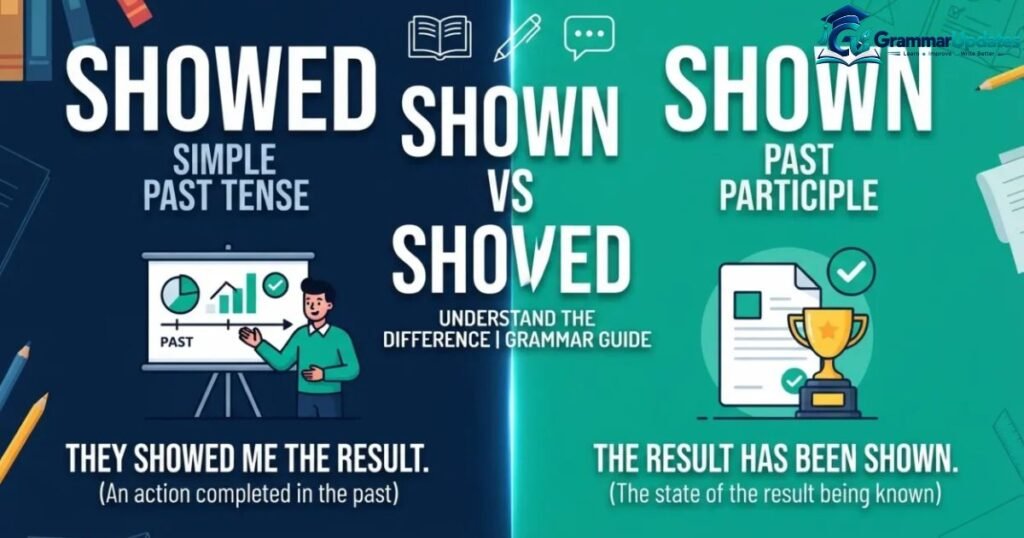
Showed : The simple past tense of “show.” It is used for an action that happened in the past.
Shown : The past participle of “show.” It is usually used with has, have, had, or be.
For Example
- She showed me her new dress.
- She has shown me her new dress.
Shown vs Showed
English verbs, “shown” and “showed” often lead to confusion due to their similar appearances and meanings. Understanding the difference hinges on their grammatical roles and verb forms. “Showed” is the simple past tense of “show,” indicating that the action of displaying or presenting something occurred and is now complete.

For instance, if you say, “She showed me her artwork,” you’re expressing a completed action in the past.
“shown” is the past participle form of “show,” used in perfect tenses or passive constructions. When you say, “The results have been shown to the public,” you emphasize that the action has relevance to the present moment, showcasing a link between past and current states.
Shown or Showed Difference
Showed: The distinction between shown vs showed is crucial for anyone keen on mastering English grammar. “Showed” serves as the simple past tense of “show,” indicating an action completed in the past, like when you say, “She showed me her artwork yesterday.” This straightforward usage provides clarity in narration, allowing the audience to easily grasp the timeline of events.
Shown: “Shown” functions as the past participle of “show,” often used in conjunction with auxiliary verbs like “has,” “have,” or “had.” For example, “She has shown great talent over the years” shifts the focus from a specific past action to an ongoing relevance.
Showed or Shown: Which Is Correct?
When it comes to the past participle of “show,” many find themselves in a quandary between “showed” and “shown.” The distinction is not only a grammatical nuance but also a reflection of how language evolves with usage.
“Shown” is the correct past participle, typically employed in perfect tenses and passive constructions. For instance, one might say, “She has shown impressive progress,” which highlights an action completed in the past with relevance to the present.
“Showed” functions as the simple past tense. You’d use it in a context like, “He showed me how to ride a bike,” where the action is complete and referenced in a straightforward past-tense narrative. Understanding this difference allows for greater clarity in communication.
Showed Is the Simple Past Form
The word showed serves as a pivotal marker in storytelling, anchoring readers in a specific moment in time. When we look back at events in our lives, using showed can instantly evoke a sense of nostalgia, allowing us to relive experiences and share meaningful lessons learned.
For example:
- She showed me her new apartment.
- We showed our guests around the city.
- He showed the teacher his homework.
- The results showed a significant improvement.
- I showed them the photograph yesterday.
The basic pattern is:
- Subject + showed + object
For example:
- Maria showed her brother the letter.
Shown Is the Past Participle
The past participle “shown” is more than just a grammatical form; it’s a key that unlocks layers of storytelling and meaning. When we think about the word itself, we often focus on its function in perfect tenses or passive constructions. But consider its ability to convey experiences and revelations.
For instance, when someone says, “What was shown in the gallery transformed my perspective,” it suggests a profound moment of insight into art as a vessel for enlightenment and understanding.
For Example
- She **has shown** remarkable patience.
- They **have shown** excellent results.
- He **had shown** me the document before the meeting.
- The evidence was **shown** to the jury.
- The results have been **shown** to be reliable.
Understanding the Verb “Show”
The verb “show” transcends its simple definition, acting as a bridge between the speaker and the audience’s understanding.

It doesn’t just imply the act of displaying; it encapsulates the art of revelation. When one uses “show,” it invites others to witness, experience, and interpret, creating a shared space infused with emotion and insight.
- Base: show
- Past: showed
- Past participle: shown
Examples:
- I show my work.
- I showed my work yesterday.
- I have shown my work many times.
Table: Verb show forms
| Form | Tense | Example |
| show | Present | I show my ID. |
| showed | Simple past | I showed my ID. |
| shown | Past participle | I have shown my ID. |
Key points:
- Only “shown” works with has/have/had
- “Showed” stands alone
When to Use “Showed” The Simple Past Tense
Understanding when to use “showed” in the simple past tense can elevate your writing clarity and effectiveness. This verb is primarily used for completed past actions, painting a vivid picture of events that are no longer ongoing.
For instance, saying “She showed her artwork at the gallery last week” not only emphasizes the event’s completion but also situates it firmly in the past, making it memorable for the reader.
Example:
- I showed my teacher the homework.
- She showed her ticket at the gate.
- They showed the photos last night.
When To Use The “Showed”
Showed pairs seamlessly with specific past-time expressions such as “yesterday,” “last week,” or “earlier,” anchoring your narrative in a clear time frame.
- The time is mentioned
- The action is completed
Examples:
- He showed me yesterday.
- We showed our project last week.
When to Use “Shown” The Past Participle
“Shown” often appears in contexts that elevate clarity and precision in language. Primarily, it is used as the past participle form of “show,” typically paired with auxiliary verbs such as “has,” “have,” or “had.”
For example, when you say, “She has shown remarkable talent,” the focus shifts seamlessly to the accomplishments that leave an impression. This highlights ongoing relevance, situating actions in a broader temporal frame while establishing a connection with the present moment.
Example:
- I have shown my passport.
- The results have been shown already.
- He had shown interest before.
How to Spot It:
- If you see has/have/had → use “shown”
Examples:
- Has shown
- Have shown
Shown or Showed Me: Which One Should You Use?
When deciding between “shown” and “showed,” it’s essential to grasp their grammatical roles. “Showed” is the simple past tense of “show,” often used in contexts where the action has been completed without lingering relevance, while “shown,” the past participle, is employed primarily with auxiliary verbs in perfect tenses or passive constructions.
For example:
you’d say, “He showed me the way,” but “The way was shown to me by him.”
Shown or Showed Up: Which Is Correct?
The debate between “shown” or “showed up” often perplexes many, as both forms stem from the verb “show,” but they serve different grammatical purposes in our language.
“Shown” is the past participle, commonly used in perfect tenses or passive constructions, conjuring images of something presented or displayed, like an art piece at a gallery.
In contrast, “showed up” is the simple past form with a more informal flavor, emphasizing the act of arriving or making an appearance, as if one is stepping into the limelight of a gathering.
Shown vs Displayed: What Is the Difference?
In the digital age: The terms “shown” and “displayed” often intermingle, yet they harbor subtle distinctions that can shift our understanding of communication and presentation. To be “shown” implies a personal touch, as if the viewer is invited into a bespoke experience, where information is presented and tailored to resonate on an individual level.
When something is “displayed”: It carries a more clinical connotation, typically devoid of personal engagement. Think of a gallery filled with artworks arranged in sterile frames; each piece is visible but doesn’t necessarily evoke a personal connection or emotional response.
If you are interested you can see more confused words Hola or Ola which help you to improve your English.
The difference lies in the interactive layer; displaying tends to present information in a more static, observational manner, while showing actively engages the viewer’s emotions, calling for a response. As we navigate an ever-evolving landscape of media and technology, distinguishing between these two terms enables us to better understand and curate our experiences, whether we’re crafting a message or simply consuming one.
Why “Shown” Matters in Perfect Tenses
In the realm of perfect tenses, the verb “shown” embodies more than just a past action; it encapsulates a complete narrative arc that connects the past to the present. When we use “has shown” or “had shown,” we are not merely recounting an event but rather emphasizing its significance in the current context or its impact on subsequent happenings.
This nuance allows the speaker to express layers of meaning, creating a tapestry of cause and effect that enriches effective communication.
- “Shown” carries meaning of experience or result
Examples:
- I have shown my skills.
- She had shown courage before.
Breaking Down Perfect Tenses with “Shown”
When we delve into perfect tenses, the verb “shown” unlocks layers of meaning that reflect completion, relevance, and continuity.
For instance, in the present perfect tense, “has shown”, we can express how past actions resonate in the present, indicating that something demonstrated previously continues to impact the current moment.
Structure:
- Present perfect: has/have + shown
- Past perfect: had + shown
Table: Perfect Tense Framework
| Tense | Structure | Example |
| Present perfect | has/have + shown | She has shown talent. |
| Past perfect | had + shown | He had shown effort. |
Key points:
- Never use “showed” after has/have/had
- Always use “shown”
Real-Life Examples showed or shown
In the realm of communication, real-life examples illuminate how language nuances can shape interactions.
For instance, consider how the phrase “I see your point” can signify agreement in a business meeting or merely acknowledge someone’s opinion in a casual conversation. This subtlety highlights the importance of tone, context, and effective communication.
Daily use:
- Emails: I have shown the report.
- Conversation: She showed me earlier.
Key tips:
- Formal writing prefers “shown” with helpers
- Casual speech may sound relaxed but rules stay the same
Comparison: “Shown” vs “Showed”
| Word | Tense | Needs Helper | Example |
| showed | Simple past | No | She showed the map. |
| shown | Past participle | Yes | She has shown the map. |
Common Mistakes and How to Avoid Them
One common mistake many make is the confusion between “shown” and “showed.” While “showed” is the simple past tense of “show,” “shown” is the past participle form. This distinction becomes particularly significant in constructions with auxiliary verbs, such as in perfect tenses.
For example, saying “I have shown” suggests a completed action and a connection to the present, whereas “I showed” refers specifically to an action that is entirely in the past. Misusing these forms can lead to awkwardness in communication, detracting from the clarity of your message.
Showed vs Shown: Self-Assessment Quiz
Try these:
- I ___ my ID yesterday. (showed/shown)
- I have ___ my ID. (showed/shown)
- She ___ the email last night.
- They have ___ the results.
- He ___ the plan earlier.
Answer Key:
- showed
- shown
- showed
- shown
- Showed
Conclusion
Understanding the distinction between Shown vs Showed is crucial for effective communication. Both forms relate to displaying or revealing something, “shown” serves as the past participle used in perfect tenses, while “showed” is the simple past form.
This difference can significantly impact the clarity of your writing, especially in more formal contexts. By mastering these nuances, you can enhance your grammatical precision and convey your ideas more clearly. So the next time you’re writing, take a moment to choose the right form, and elevate your language skills!
FAQs
Is Shown or Showed Used in UK English?
In UK English, “shown” is the correct past participle of “show.” It is commonly used in both written and spoken contexts. For example, one might say, “I have shown you the documents,” or “The results were shown at the meeting. “showed” is the simple past tense of “show.” You would use it when referring to a specific moment in the past, as in “He showed me the way yesterday.”
Have I shown you or have I showed you?
The correct phrase is “Have I shown you?” The present perfect tense “have shown” is used to indicate that an action was completed at some unspecified time in the past and has relevance to the present moment. “Showed” is the simple past tense, which is typically used for actions that occurred at a specific time in the past. In this case, since you’re referring to a potentially ongoing relevance, “shown” is the appropriate choice.
Is shown correct grammar?
Yes, “shown” is correct grammar when used in the right context. It is the past participle form of the verb “show” and is commonly used in perfect tenses, passive voice, and as an adjective. For example, one might say, “The results have been shown to be accurate,”
Which is correct: “I have shown” or “I showed”?
Both “I have shown” and “I showed” are correct, but they are used in different contexts. “I have shown” is in the present perfect tense. Example, “I have shown my work to several clients.” “I showed” is in the simple past tense, referring to a specific event that happened at a defined time in the past. You would use this when talking about a completed action: “I showed my work to the client last week.”
Who has shown or showed?
The choice between “has shown” and “showed” depends on the context and timeframe. “Has shown” is the present perfect tense, indicating an action that occurred at an unspecified time and has relevance to the present, while “showed” is the simple past tense, referring to a completed action in the past.
Is it correct to say “shown”?
Yes, it is correct to say “shown.” The word “shown” is the past participle of the verb “show,” and it is commonly used in various contexts. For instance, in sentences like “The results have been shown to be effective,” it indicates that something has been demonstrated or revealed in the past.







One Comment