
Breath or Breathe: What is the Difference, Rules, And Examples (2026)
Our breath is the foundation of life, intricately tied to our physical and emotional well-being. We’ll explore the nuances between “Breath or Breathe,” and why understanding this distinction can enhance your awareness of your own breathing practices.
By the end, you’ll gain valuable insights into how to harness the power of your breath for better health and mindfulness. The average person takes about 20,000 breaths a day.
Breath or Breathe: What Is the Difference?
Breath : When exploring the words “breath” and “breathe,” one might stumble upon an intriguing distinction that reflects deeper aspects of language. “Breath,” a noun, encapsulates the vital air that fills our lungs, representing life itself. It evokes a sense of calm and presence; think of that deep inhale before a moment of clarity or the release of tension in a slow exhale.
Breathe : The verb, paints a dynamic picture of action, an invitation to engage in the rhythmic dance between inhaling and exhaling. It signifies more than just physical respiration; it carries the weight of mindfulness and emotional release.
Breath is a Noun
Breath, as a noun, embodies more than just the act of inhaling and exhaling; it symbolizes a profound connection to life itself.
For example:
- I took a deep breath.
- She held her breath.
- He was out of breath after running.
- Take a breath before you answer.
- His breath smelled like coffee.
Breathe is a Verb
Breathing is often perceived as a passive act, but when we frame it as a verb, it transforms into an active choice laden with intention and awareness.
Examples include:
- Try to breathe slowly.
- I can hardly breathe in this smoke.
- She breathes deeply before meditation.
- Remember to breathe while exercising.
- The baby is breathing normally.
It can also appear in different verb forms:
- breathe
- breathes
- breathed
- breathing
For example:
- I breathe slowly when I am relaxed.
- She breathes through her nose.
- He breathed a sigh of relief.
- They were breathing heavily after the race.
The One-Second Rule
If you are unsure which word to use, ask:
“Am I naming the thing, or describing the action?”
- Naming the thing → breath
- Describing the action → breathe
Breath vs Breathe: Grammar Rules You Need to Know
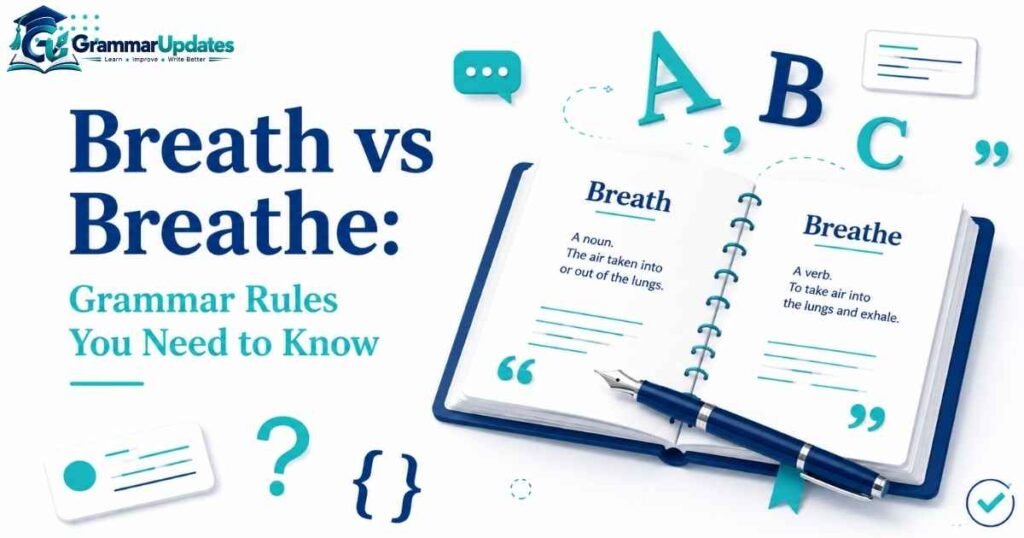
Understanding the distinction between “breath” and “breathe” can significantly enhance your writing clarity. “Breath,” a noun, denotes the act of inhaling and exhaling, while “breathe,” a verb, refers to the action itself.
Picture a serene moment: you take a deep breath of fresh air to calm your mind. Here, “breath” encapsulates that moment of stillness, yet the act of doing so is captured in “breathe” , an ongoing process that sustains life.
To avoid common pitfalls, remember that the verb “breathe” requires an emotional or physical context. “The baby began to breathe” illustrates vital life, whereas one may take a shallow breath in anxious moments.
An imaginative way to internalize this is to think of “breath” as a tangible thing you can hold, and “breathe” as the dynamic action of filling your lungs. With these nuances in mind, you can transform your writing by ensuring each word precisely conveys your intended meaning, creating a more engaging connection with your readers.
- Breath. “Breath” (which rhymes with “death”) is the air inhaled or exhaled during breathing. For example:
- He took his last breath.
- Breathe. “Breathe” (which rhymes with “seethe”) means to inhale and expel air from the lungs. For example:
- I can’t breathe
Use “Breath” After Articles and Determiners
Incorporating the word “breath” after articles and determiners can add a unique layer of meaning and imagery to your writing. Consider how “a breath of fresh air” conveys not just physical inhalation, but also a metaphorical sense of rejuvenation and new ideas.
Examples:
- Take a breath.
- I held my breath.
- She took another breath.
- He lost his breath.
- We could see each breath in the cold air.
A very common mistake is writing:
Take a breathe. (wrong)
The correct version is:
Take a breath. (correct)
Why? Because take needs a noun in this expression, and breath is the noun.
Use “Breathe” After “To”
To breathe is to embrace the essence of life itself, an act so simple yet profoundly significant. By consciously taking a moment to breathe, we can transform our routine existence into a mindful experience.
Examples:
- I need to breathe.
- Try to breathe slowly.
- She wants to breathe fresh air.
- It is difficult to breathe here.
- Remember to breathe.
This gives you another useful test:
to breathe → correct
to breath → usually incorrect
For example:
I need to breathe.
Not:
I need to breath.
Watch the Verb Forms
In the realm of language, the verb forms of “watch” may not seem immediately captivating, but consider this: just as our breath animates our existence, the nuance in verb forms brings life to our communication. When we say “watch,” we engage with the present action, a vibrant moment filled with anticipation and excitement.
| Form | Example |
| Breathe | I breathe slowly. |
| Breathes | She breathes deeply. |
| Breathed | He breathed a sigh of relief. |
| Breathing | They are breathing normally. |
How to Pronounce “Breath” and “Breathe”
Many often confuse the pronunciation of “breath” and “breathe,” like (Hola or Ola) but understanding the subtle differences can elevate your linguistic finesse.
“Breath,” pronounced with a short ‘e’ as in “set” (brɛθ), refers to the act of inhaling and exhaling air. Think of it as the noun form that captures the essence of our vital air exchange.
“breathe” features a long ‘e’ sound (briːð), indicating the action of taking a breath. This verb form encompasses the dynamic process of drawing in oxygen.
More about “Breath”
Breath is not just a physical act; it’s a profound connection to our emotional and spiritual selves. When we consciously breathe, we enter a state of awareness that can transform our entire experience of life.
Example sentences with “breath”:
- Paul pinched his nose, took a breath and jumped off the boat.
- He would fight until his last breath.
More about “Breathe”
The act of breathe is often taken for granted, yet it holds profound significance in both our physical and emotional lives. Each inhalation is a reminder of our connection to the present moment, a gentle nudge to engage more deeply with our surroundings.
(1) To inhale and expel air from the lungs
- I can’t breathe.
- Is she breathing?
- (Note that “breathe” drops the “e” when “ing” is added.)
(2) To allow gas or moisture to pass through
The new synthetic material can breathe to prevent moisture building up against the skin.
(3) To impart (often used figuratively)
- He breathed new life into the project.
- He breathed a sigh of relief.
Breath vs Breathe
The confusion between “breath” and “breathe” occurs only in writing. Therefore, if you use the “e” on the end of “breathe” to remind you that the syllable “ea” is pronounced EE (i.e., “breathe” rhymes with “seethe”), then you will eliminate this error. If you like, you can also check out my other guides on common word confusions, such as “shown vs. showed.”
Breath or Breathe of Fresh Air: Which Is Correct?
Understanding the difference between “breath” and “breathe” can clarify everyday conversations, yet many people find themselves stumbling over these two words. “Breath” is a noun referring to the air taken into or expelled from the lungs
“breathe” is a verb describing the action of inhaling and exhaling. This distinction is vital not only in writing but also in speech, as using one in place of the other can lead to confusion and miscommunication.
Breath or Breathe in the UK
The distinction between “breath” and “breathe” often slips by unnoticed, yet it reveals the complexity of language and the subtleties embedded in everyday communication.
In the UK, where the rhythm of life can often feel frenetic, pausing to consider one’s breath both as an act and as a concept offers a refreshing perspective on mindfulness and well-being.
“Breath” serves as a powerful reminder of our humanity, a physical act tightly interwoven with our emotional states and mental clarity.
“breathe” embodies the dynamic process of inhalation and exhalation, inviting us to embrace the present moment.
Breath or Breathe: Meaning and Usage
Understanding the distinction between “breath” and “breathe” can elevate your writing and communication.
“Breath,” a noun, refers to that vital air we inhale and exhale it’s the essence of life. When used in phrases like “taking a breath,” it evokes a sense of pause, reflection, and the importance of mindful living.
“breathe,” the verb form, invites action. To breathe is to engage in a rhythmic dance with life, emphasizing the importance of consciousness in our respiratory process. It’s an active choice, reminding us that we have the power to influence our state of being through mindful breathing techniques.
Breath or Breathe: Correct Spelling
Understanding the distinction between “breath” and “breathe” can be more than just a grammatical exercise; it can also enrich our appreciation of language.
- Breath (without an “e”) is a noun.
- It means the air you inhale and exhale, or a single act of taking air in.
- Example: “Take a deep breath.”
- Example: “He has minty fresh breath.”
- Breathe (with an “e”) is a verb.
- It describes the action of inhaling and exhaling air.
- Example: “Remember to breathe.”
- Example: “It is hard to breathe when you run fast.”
Breath or Breathe: Which Word Should You Use?
In poetry and prose, choosing the correct term can inject deeper meaning into your expressions. For instance, “taking a deep breath” conveys a moment of pause and reflection, an invitation to embrace the present.
To “breathe in the fresh air” evokes the dynamic connection with nature, invoking sensory experiences that resonate with readers. By mastering these subtleties, you can enrich your language and engage your audience more profoundly, ensuring your message resonates on multiple levels.
Breath or Breathe Out: Which Is Correct?
When deciding between “breath” and “breathe out,” it’s essential to recognize that they serve different grammatical purposes, each contributing uniquely to the art of expression.
“Breath” is a noun, referring to the very act of inhalation or exhalation, while “breathe” is the verb that encapsulates the action itself. This distinction may seem subtle but understanding it can deepen our appreciation for language and how we communicate our experiences.
To “breathe out” can symbolize release and letting go an act of freeing oneself from tension, stress, or negativity.
In contrast, “breath” embodies the essence of life itself, a reminder of our connection to nature and the rhythms that sustain us.
Take a Breath or Breathe: Which Is Correct?
In the often-overlooked world of language, the phrase “take a breath” and the more alternative “breathe” serve distinct purposes, and understanding their nuances can enrich our communication.
“Take a breath” implies a deliberate action, a momentary pause to gather one’s thoughts or regain composure.
On the other hand, “breathe” can be viewed as a broader, almost poetic expression of life itself. It signifies not just the physical act of breathing, but also the emotional and spiritual recesses we traverse. To breathe is to exist fully in the moment, tapping into every aspect of our being.
Breath or Breathe: Examples You Can Copy
Understanding the difference between “breath” and “breathe” can elevate your writing and communication. “Breath” is the noun that refers to the air you inhale and exhale, while “breathe” is the verb that describes the action itself.
To illustrate, consider these examples: “After a long run, I took a deep breath to regain my composure,” versus “I need to breathe deeply to calm my racing heart.” This distinction not only clarifies your intentions but also enriches your storytelling.
Correct “Breath” Examples
- I took a deep breath before speaking.
- She held her breath underwater.
- He was out of breath after the race.
- Take a breath and relax.
- I could see his breath in the cold air.
- She needed a moment to catch her breath.
- He whispered the answer under his breath.
- Take one more breath before you begin.
- The exercise made my breath faster.
- I could smell garlic on his breath.
Correct “Breathe” Examples
- Try to breathe slowly.
- Remember to breathe during the exercise.
- She breathes deeply when she meditates.
- I can hardly breathe in this room.
- He stopped to breathe after running.
- The baby is breathing normally.
- She breathed a sigh of relief.
- You should breathe through your nose.
- It was difficult to breathe in the smoke.
- Take your time and breathe.
Incorrect vs Correct
| Incorrect | Correct | Why? |
| Take a breathe. | Take a breath. | Noun needed |
| I need to breath. | I need to breathe. | Verb needed |
| Try to breath slowly. | Try to breathe slowly. | Verb needed |
| She took a deep breathe. | She took a deep breath. | Noun after “a” |
| I can hardly breath. | I can hardly breathe. | Action is required |
| Hold your breathe. | Hold your breath. | Fixed noun expression |
| He was out of breathe. | He was out of breath. | Fixed noun expression |
| Breathe deeply. | Breathe deeply. | Verb is correct |
A Real-Life Example: Why the Difference Matters
Consider a dedicated athlete preparing for competition. Their coach emphasizes the importance of proper Breathing Techniques and how to breathe deeply and rhythmically, fueling their body with oxygen. This focus on breath not only enhances performance but also acts as a mental anchor.
In high-pressure situations, a few deep breaths can regulate heart rate, calm nerves, and sharpen focus. This isn’t merely about taking a breath; it’s about mastering the art of breath to unlock potential.
On the flip side, imagine someone caught in a stressful moment, gasping for breath instead of breathing deeply. This difference can lead to panic, decreased performance, and mental fatigue. Understanding the distinction between breath and breathe reveals how our response to stress directly affects our physical and mental well-being.
By learning to breathe intentionally, we empower ourselves to handle challenges with poise, illuminating how these often-overlooked moments can make all the difference in achieving our personal best.
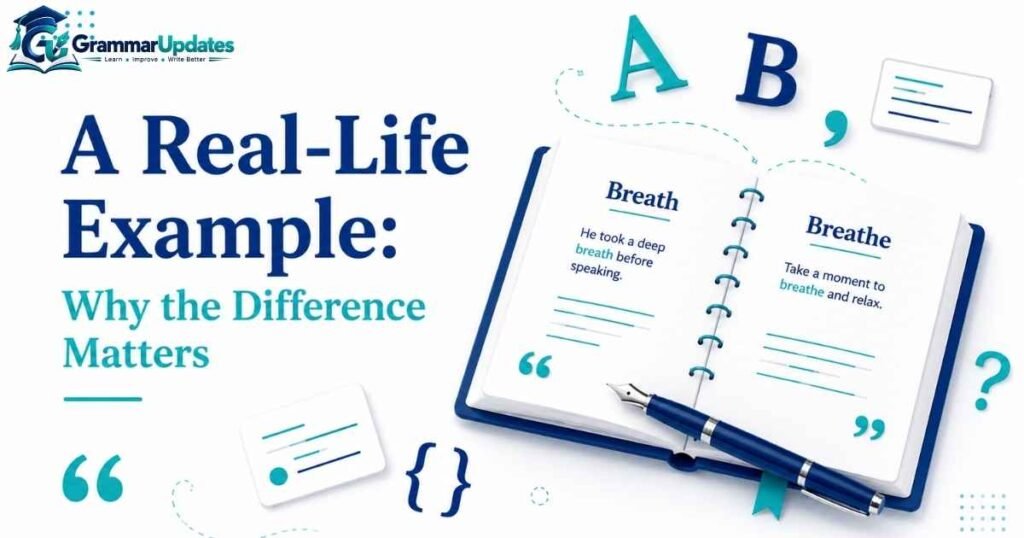
- “Take a deep breath and breathe slowly.”
- “take a deep breath,”
- “I took a deep breath before starting my presentation. I tried to breathe slowly so I would not speak too quickly.”
A Simple Step-by-Step Method to Choose the Right Word
Choosing the right word can transform your writing, infusing it with clarity and emotion. One effective method is to start by considering the core message you want to convey.
Take a moment to breathe and reflect on the feelings your words should evoke. Jot down synonyms for your initial choice, allowing yourself to explore the nuances each word carries.
Step 1: Look at the Sentence
Read the complete sentence instead of focusing only on the two words.
For example:
I need to ___.
The sentence needs an action, so breathe is correct.
I took a deep ___.
The sentence needs a noun, so breath is correct.
Step 2: Ask “Thing or Action?”
This is the most important question.
Thing → breath
Action → breathe
For example:
Take a breath.
Breathe slowly.
Step 3: Look for Clue Words
Some words provide strong clues.
Words and expressions commonly associated with breath include:
- a
- my
- your
- his
- her
- deep
- short
- hold
- catch
- out of
Words and structures commonly associated with breathe include:
- to
- can
- should
- try to
- need to
- breathe in
- breathe out
- slowly
- deeply
Step 4: Read It Aloud
If you are still uncertain, pronounce both options.
Breath → “breth”
Breathe → “breeth”
The pronunciation difference can help your brain connect the correct spelling with the correct grammatical role.
Self Assessment Quiz breath and breathe
Try These:
- Take a deep ___ before you speak. (breath/breathe)
- Try to ___ slowly when you feel nervous. (breath/breathe)
- I need to ___ before I continue. (breath/breathe)
- She took another ___ and continued speaking. (breath/breathe)
- Remember to ___ while exercising. (breath/breathe)
- He was out of ___ after running upstairs. (breath/breathe)
- Hold your ___ for a few seconds. (breath/breathe)
- Take a deep ___, then ___ slowly. (breath/breathe)
Answer Key:
- breath
- breathe
- breathe
- breath
- breathe
- breath
- breath
- breath / breathe
Conclusion
The distinction between Breath or Breathe is vital for effective communication. While “breath” serves as a noun, indicating the air we take in and expel, “breathe” functions as a verb, representing the action of inhaling and exhaling. These terms are often used interchangeably in casual conversation, but recognizing their differences can enhance clarity in both writing and speech.
As we continue to explore the nuances of the English language, let us pay attention to these small yet significant details. Consider revisiting your writing and ensuring you’re using the correct form; your precision will surely reflect your mastery of the language.
FAQs
Is Breathe Correct or Breath?
Breath is the noun that refers to the air taken in or expelled from the lungs, while breathe is the verb that describes the action of inhaling or exhaling. For example, you take a deep breath when you breathe in.
How do you use Breath and Breathe?
Breath is a noun that refers to the air taken in or expelled by the lungs, as in “Take a deep breath.” Breathe is a verb, meaning the action of inhaling or exhaling, such as “Make sure to breathe deeply during meditation.”
When should I use Breath vs Breathe?
Breath is a noun that refers to the air taken into or expelled from the lungs, while breathe is a verb that means to inhale and exhale air. For example, you take a breath when you inhale, but you need to breathe continuously to stay alive.
Is it hold my Breath or Breathe? Is it hold my Breath or Breathe?
Hold my breath is correct when referring to the act of pausing your breathing, often in anticipation or fear. On the other hand, breathe simply means to take in air and expel it, which is essential for life.