Drier or Dryer: What is the Difference and Which Word Is Correct?
In the case of “Drier or Dryer,” those tiny distinctions can lead to confusion in everyday conversation. Understanding which term to use not only enhances your communication skills but also reflects your attention to detail in the English language.
You will be the expert after clear this concept. We’ll unravel the differences between these two commonly misused terms and why getting it right matters.
Drier or Dryer Meaning
The confusion between “drier” and “dryer” often brings a chuckle, but digging deeper unveils interesting nuances.
“Drier,” as an adjective, paints a picture of something with less moisture, conjuring images of arid landscapes or the crispness of autumn leaves. It’s a word laden with evocative potential, suggesting not just a state of dryness but the transformative journey of desiccation thinking of how our emotional landscapes can feel drier in the colder months, reflecting a longing for warmth and connection.
“Dryer” refers specifically to the device we rely on to remove moisture from clothes. This appliance has revolutionized domestic living, transforming laundry days from laborious, sun-dependent undertakings into swift, efficient tasks. In which by the process of machine we remove the water or moisture from the clothes.
While “drier” and “dryer” may seem like simple missteps in grammar, they open the door to broader discussions about nature, technology, and sustainability in our daily lives.
What Does “Drier” Mean?
“Drier,” as a comparative adjective, invites a fascinating exploration of its various contexts. Often confused with “dryer,” which refers to a device used for drying clothes, “drier” encapsulates the essence of reduced moisture levels, whether in weather, soil, or any number of other materials.
Drier Means “More Dry”
“Drier” finds relevance in our everyday choices, especially when it comes to fabric care. By recognizing the implications of drier laundry settings, we can better understand how heat affects the longevity of our garments.
The basic pattern is:
dry → drier → driest
For example:
- The clothes are dry.
- The clothes outside are drier than the clothes inside.
- These are the driest clothes in the basket.
Drier Can Also Be a Noun
In the realm of language, “drier” can take on a dual identity, transcending its typical role as a comparative adjective to become a noun that represents a vital player in various industries.
This intriguing aspect often goes unnoticed, yet understanding its usage can enhance our appreciation for the subtleties of communication.
For example, in culinary arts, a “drier” may refer to an essential tool for dehydrating fruits and vegetables, allowing them to retain nutrients while extending their shelf life.
Why “Drier” Looks Like the Obvious Choice
In a world where dampness often equates to discomfort, “drier” emerges as the clear champion for those seeking a refreshing escape. But it’s not just about avoiding moisture; it’s about embracing a lifestyle that enhances well-being.
A drier environment promotes better air quality, curbing allergens and mold, ultimately leading to a healthier living space. By opting for drier conditions, individuals are investing in their physical and mental health, creating an atmosphere that is not only more pleasant but also more energizing.
- dry → drier
- dry → driest
What Does “Dryer” Mean?
The term “dryer” extends beyond its primary association with laundry. In various contexts, it embodies a unique interplay of technology, environment, and even aesthetics.
For instance, in culinary discussions, a “drying” method refers to techniques that enhance flavor concentration, think sun-dried tomatoes or dehydrated herbs. Here, the dryer becomes a tool not just for removing moisture but for intensifying sensory experiences.
Clothes Dryer
The clothes dryer has evolved far beyond its traditional role of simply drying laundry. Today, it stands as a player in the eco-friendly movement, with energy-efficient models that significantly reduce electricity consumption. The clothes dry by the air.
For example:
- The washing machine has finished, so I will put the clothes in the dryer.
- The dryer stopped before the clothes were completely dry.
- In American English, dryer is particularly common for this appliance.
Hair Dryer
In the ever-evolving world of beauty tools, the hair dryer stands out not just for its practicality but for its potential to transform hairstyles in moments.
Example
She used a hairs dryer after washing her hair.
Both hair dryer and hair drier shall be found, but hair dryer is the familiar modern spelling for the appliance.
Other Types of Dryers
While traditional tumble dryers dominate the market, innovative alternatives are reshaping how we tackle laundry. Heat pump dryers are gaining popularity due to their energy efficiency; they use a closed-loop system that recycles hot air, extracting moisture at lower temperatures.
On the other hand, ventless dryers are a game-changer for those in apartments or homes lacking external venting options.
- hand dryer
- grain dryer
- tumble dryer
- spin dryer
- industrial dryer
- food dryer
- clothes dryer
For example:
- The restaurant installed a new hand dryer.
- Farmers use a grain dryer to reduce moisture in harvested grain.
- The hotel has a washing machine and tumble dryer.
Drier or Dryer: What Is the Difference?
When deciding between “drier” and “dryer,” many people are unsure of the distinction, which can lead to amusing misunderstandings.
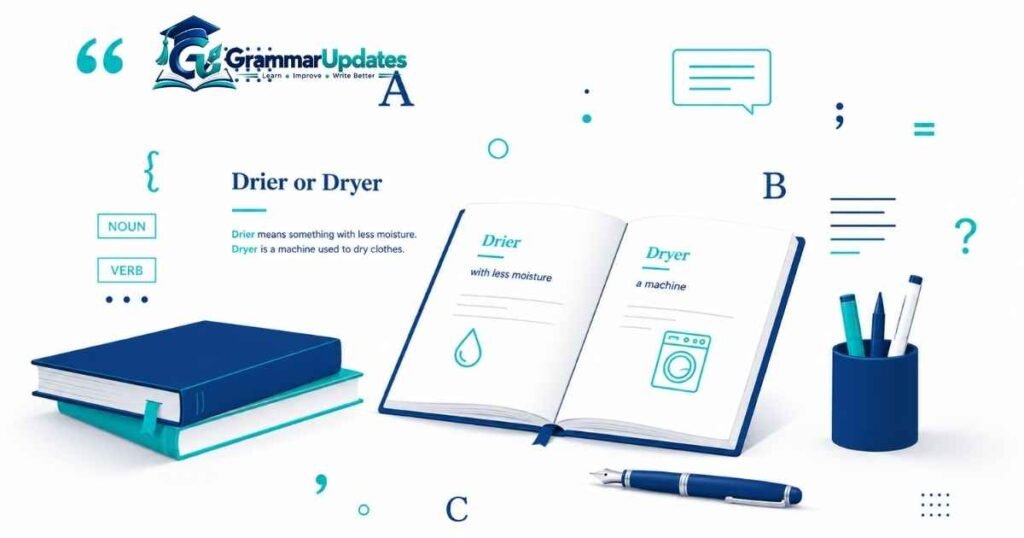
“Drier,” an adjective, describes a state of reduced moisture, think of a desert climate or that moment when your towel finally reaches the perfect level of dryness.
“Dryer” refers specifically to the appliance most people can’t live without, transforming soggy clothes into fresh, wearable garments.
What is “Drier”?
“Drier,” an adjective, describes something characterized by a low moisture content. For instance, a drier climate can significantly affect local ecosystems and agriculture, impacting everything from crop yields to water supply.
Examples:
- “This climate is drier than before.”
- “The towel became drier in the sun.”
What is “Dryer”?
“Dryer” is a noun referring to an appliance that removes moisture from clothes or other materials. Modern dryers are evolving beyond mere convenience to incorporate energy efficiency and smart technology, allowing users to monitor cycles remotely through their smartphones.
Examples:
- “The clothes are in the dryer.”
- “She bought a new hair dryer.”
Drier or Dryer
When considering “drier” versus “dryer,” the choice may seem trivial, yet it opens up a fascinating conversation about language nuances. While “dryer” refers specifically to an appliance used for drying clothes, “drier” serves as an adjective describing something with less moisture.
This subtle distinction highlights the beauty of English, a language rich with dual meanings that can influence not just grammar but also the flow of conversation.
Drier or Dryer: What Is the Correct Word?
The nuances of the English language can be dazzling, particularly when faced with homophones like “drier” and “dryer.” While both words may sound similar, they serve distinct functions.
“Drier,” the comparative form of “dry,” is used when comparing moisture levels, think of a desert versus a tropical rainforest.
“Dryer” refers to a device, often a household appliance, that removes moisture from clothes or hair.
This distinction is essential in ensuring clarity in communication, especially in settings where precision is paramount.
Drier as a Comparative Adjective
When we think about the comparative adjective “drier,” it transcends the mere notion of moisture or lack thereof. It invites us to explore an intriguing spectrum of comparison that resonates in various contexts, from weather patterns to the subtleties of personal experiences.
For instance, when saying, “Today is drier than yesterday,” we not only reflect on the weather but also engage in a dialogue about change. Each day brings a new reality, hinting at the fluidity of circumstances that can shape our mood and well-being.
For example:
- This towel is drier than that one.
- The weather is drier today.
- My skin feels drier in winter.
- The soil is drier than it was last week.
- This climate is drier than the coastal region.
Dryer as a Machine or Device
The clothes dryer, an indispensable appliance in modern households, transcends its primary function of drying garments. As a machine designed to efficiently remove moisture from freshly washed clothes, it embodies innovation in energy use and design.
Examples include:
- clothes dryer
- hair dryer
- hand dryer
- grain dryer
- tumble dryer
- spin dryer
The Quickest Rule to Remember
A useful everyday rule is: “Drier = more dry, Dryer = a machine that dries.” This simple mnemonic can prevent confusion in conversations and writing, especially in an age where clarity is paramount.
Often, the nuances of our language can lead to misunderstandings, but remembering this rule can streamline communication and enhance your expressive prowess.
A useful everyday rule is:
Drier = more dry
Dryer = a machine that dries
Drier or Dryer Machine
When considering the benefits of a dryer, it’s easy to overlook its impact on both convenience and energy efficiency. Many of us might say, “I put my clothes in the dryer,” not realizing that this appliance not only saves time but also reduces the wear and tear that comes with traditional drying methods.
As newer models hit the market, features like moisture sensors and eco-friendly settings are revolutionizing laundry day, allowing you to customize your drying experience and save on energy bills.
The concept of “drier” extends beyond just the clothes in your laundry. The difference in climate, air circulation, and humidity levels can profoundly affect how quickly your garments dry outside. In regions with lower humidity, you might find that “the clothes are drier now” faster than ever, making outdoor drying more efficient.
This contrast showcases a delicate balance between modern technology and nature’s efficiency, prompting a thoughtful consideration of when to embrace the dryer and when to let fresh air do the work.
Drier or Dryer for Washing Machine
When discussing laundry appliances, clarity in terminology is essential. The correct term for the machine that dries clothes after washing is “dryer.”
While “drier” may seem like a plausible alternative, it refers to something that is less moist or comparative dryness, not the drying appliance we use in our homes. Understanding this distinction helps us communicate more effectively about laundry tips and machine functionality.
Many modern washer-dryer combos now boast advanced drying functions, seamlessly integrating washing and drying into a single cycle. This innovation saves both space and time, making it easier for busy households to manage their laundry.
When shopping for a “dryer,” consider energy efficiency and drying capacity to suit your lifestyle needs. Remember, the choice of terminology matters not only does it reflect your knowledge, but it also enhances conversations around appliances that play a significant role in our daily lives.
Drier or Dryer UK
In the UK, the distinction between Shown vs Showed and “drier” and “dryer” often leads to confusion, but understanding their unique contexts can enhance both communication and clarity in daily life.
Using “drier,” the comparative adjective, often evokes discussions around climate like the shift toward a drier season or the impact of climate change on our weather patterns.
“dryer” pertains to the practical appliances we rely on. With the rise of compact living spaces in urban areas, the popularity of energy-efficient dryers has soared.
These machines not only save time but also help us adapt to the vagaries of British weather, especially when the sun shines less frequently. Investing in a quality dryer can streamline household chores, making it easier to maintain a cozy and comfortable home despite the dampness outside.
Drier or Dryer Machine Price
When considering the purchase of a dryer machine, understanding its price range can significantly influence your choice. Typically, dryer machine prices vary based on features, energy efficiency, and brand reputation.

While essential models may start around $300, high-efficiency or smart appliances can easily climb into the $1,500 range or more. Investing in a top-tier dryer machine not only enhances your laundry experience but can also lead to savings on energy bills in the long term.
Drier or Dryer Weather
When discussing drier or dryer weather, it’s fascinating to consider not just the terminology but the profound impact that changing conditions have on our environment.
Drier weather, indicative of lower humidity and reduced precipitation, can shift ecosystems in ways that often go unnoticed until it’s too late. Just as they use in the other commonly confused words “Breath or Breathe”.
Vegetation becomes stressed, leading to a decrease in biodiversity and altering the habitats of countless species. Farmers face the challenge of adjusting irrigation practices to sustain crops, which can lead to debates about water rights and resource management.
Drier or Dryer Wine
When exploring the world of wine, the terms “drier” and “dryer” can provoke confusion, yet they embody distinct experiences.
A “drier” wine is characterized by its low residual sugar content, often delivering a crisper, more refreshing palate.
The appeal of dry wines lies in their ability to amplify the nuanced flavors of berries, herbs, and spices, allowing the drinker to appreciate the terroir where the grapes are grown more intimately.
For instance, a dry Riesling or a Sauvignon Blanc can evoke images of sunlit vineyards, enhancing the sensory experienc
Drier or Dryer for Clothes
“Dryer” is the more common term for the appliance that removes moisture from our clothes, “drier” serves as the comparative adjective describing a lesser amount of moisture.
This linguistic nuance not only reflects how we communicate but also hints at our evolving relationship with technology. In an age where energy efficiency and eco-conscious choices are paramount, understanding the drying process can be as crucial as the device itself.
Consider the various methods of drying clothes, from traditional lines to the modern mechanical dryer. Line drying, a practice favored for its sustainability, offers an opportunity to embrace nature; a gentle breeze can save energy while imparting a fresh scent to fabrics.
Drier vs Dryer: The Main Difference
When discussing Drier or Dryer it’s fascinating to delve into their functional nuances.
“Drier,” often an adjective, refers to something that has less moisture, like a drier climate or drier clothes. It’s intriguing how this term shapes our understanding of environmental conditions; a drier atmosphere.
For example, it can influence not just personal comfort but also agricultural practices. If you are interested so check my other commonly confusion words Hola or Ola with clear examples.
“Dryer” denotes the appliance we all rely on to remove moisture from our clothes and fabrics. This machine plays a pivotal role in modern convenience, transforming our laundry day from a prolonged chore into a quick task.
Drier Is Usually an Adjective
“Drier,” an adjective, conveys a state of reduced moisture, whether you’re discussing the weather, a dessert’s texture, or a literary work’s emotional landscape.
For instance, describing a region as “drier” can evoke images of parched earth and sun-bleached landscapes, inviting readers to engage their senses and experience the environment vividly.
Compare:
The towel is dry.
With:
The towel is drier now.
And:
This towel is drier than that one.
Here, drier tells us about the condition of the towel.
Dryer Is Usually a Noun
“Dryer,” as a noun, conjures thoughts of household appliances that make contemporary life more convenient. A dryer often symbolizes modernity and comfort, transforming laundry chores into a swift process.
For example:
The dryer is running.
The dryer needs to be cleaned.
We bought a new dryer.
A Simple Comparison Table
| Word | Typical role | Meaning | Example |
|---|---|---|---|
| drier | Adjective | More dry | This towel is drier. |
| dryer | Noun | A machine/device that dries | The clothes are in the dryer. |
| drier | Noun | A drying device/substance | The clothes are in the drier. |
| dry | Adjective | Free from moisture | The towel is dry. |
| driest | Superlative adjective | Most dry | This is the driest towel. |
Drier or Dryer in American and British English
In American English, “dryer” refers primarily to the appliance used for drying clothes, while “drier” serves as the comparative form of “dry.” This distinction can lead to amusing misunderstandings, especially for non-native speakers.
Imagine someone discussing their latest laundry innovation and accidentally calling it a “drier.” It’s not just a slip of the tongue; it sparks a moment of confusion, illustrating how language nuances can enrich everyday conversations.
British English embraces both terms more fluidly, though “dryer” is still recognized when talking about the laundry appliance. Here, “drier” is more often used to describe the weather or conditions “It’s been drier than expected this summer” highlighting that language can also reflect cultural variations in lifestyle.
American English
In American English, one might say, “I put my clothes in the dryer,”
Examples:
I need to buy a new clothes dryer.
Where is the hair dryer?
The dryer is making a strange noise.
British English
While in British English, the phrase morphs to:
- “I put my clothes in the tumble dryer.”
Which Form Should Writers Prefer?
Use:
The clothes are drier now.
when you mean more dry.
Use:
Put the clothes in the dryer.
when you mean the machine.
That distinction gives readers the least possible room for confusion.
Drier or Dryer: Common Examples You Can Copy Examples With “Drier”
Use drier when comparing dryness:
- The air is drier today than yesterday.
- My skin feels drier during cold weather.
- This towel is drier than the other one.
- The soil becomes drier during the summer.
- The paint will be drier by tomorrow.
- The northern region is generally drier than the south.
- These clothes are drier because they were left outside.
- The climate is getting drier each year.
Notice that drier describes a condition in each example.
Examples With “Dryer”
Use dryer when referring to a machine or device:
- The clothes are in the dryer.
- I bought a new dryer last month.
- The dryer stopped working.
- Please clean the dryer filter.
- Where did you put the hair dryer?
- The hotel provides a hair dryer.
- The grain dryer removes excess moisture.
- The hand dryer is near the restroom entrance.
Here, dryer identifies a device.
Examples Where Both Words Appear
Sometimes both words can naturally appear in one sentence:
- The clothes are drier because I put them in the dryer.
- The first word describes the clothes.
- The second word identifies the machine.
Another example:
- The towel became drier after I put it in the dryer.
- This is an excellent way to remember the distinction.
Everyday Real Life Examples
A drier approach characterized by straightforwardness and minimal embellishment tends to resonate in academic or technical writing, where clarity and precision reign supreme. Opting for a dryer narrative can feel monotonous, risking reader engagement.
In Weather
- “This season is much drier.”
In the Home
- “The dryer stopped working.”
In Daily Life
- “My skin gets drier in winter.”
- “She used a hair dryer.”
In Messages
- “The air feels drier today.”
Common Mistakes People Make
- Writing “dryer” when comparing moisture.
- Incorrect: This towel is dryer than that one.
- Correct: This towel is drier than that one.
- Writing “drier” when referring to a machine.
- Incorrect: Put the clothes in the drier.
- Correct: Put the clothes in the dryer.
- Assuming both spellings are interchangeable.
- They are not interchangeable because they have different grammatical functions.
Using “dryer” for comparisons
❌ “The weather is dryer today.”
✔ “The weather is drier today.”
Using “drier” for machines
❌ “Put the clothes in the drier.”
✔ “Put the clothes in the dryer.”
Forgetting context
One is about comparison, the other is usually an object.
Common Mistakes With Drier and Dryer
Many people often confuse “drier” and “dryer,” and this discrepancy can lead to both grammatical errors and miscommunication. While “dryer” refers to the appliance that removes moisture from clothes, “drier” can describe a state of dryness or something that causes drying.
Mistake 1: Treating “Drier” as Always Wrong
Incorrect assumption:
- “Drier is never correct.”
That is false.
Drier is the normal comparative form of dry, and dictionaries also recognize it as a noun.
Correct:
- The weather is drier this year.
Mistake 2: Using “Dryer” When You Mean “More Dry”
Consider:
- This towel is dryer than that one.
Although readers will understand the sentence, drier is the standard comparative form.
Better:
- This towel is drier than that one.
Mistake 3: Assuming “Dryer” Is Incorrect Mistake
That is also incorrect.
Dryer is a fully established noun for a machine or device that dries something. Cambridge, Oxford, and Merriam-Webster all recognize it.
4: Ignoring the Context
Ask:
- Am I comparing dryness?
- If yes, drier is probably correct.
Ask:
- Am I naming a machine?
- If yes, dryer is usually the clearest choice.
How to Remember Drier vs Dryer
When it comes to remembering the distinction between “drier” and “dryer,” it helps to associate each term with its context. Think of “drier” as an adjective describing something that has less moisture, akin to a sunny day that leaves your clothes drier than before. You can visualize a desert landscape dry and arid to help cement this meaning in your mind.
“Dryer” refers specifically to the appliance that helps dry clothes. To make it stick, picture yourself loading wet laundry into a “dryer”; it’s an action-driven image that links directly to its function.
Consider even the spelling: the letter “y” in “dryer” resembles the shape of a spinning drum, emphasizing its role in that process. By creating these vivid mental connections, you’ll easily navigate the nuances of drier vs. dryer in your writing.
Think “More Dry” for Drier
Break it down mentally:
dry → drier
Just like:
- bright → brighter
- light → lighter
- quiet → quieter
So:
The room is drier.
means:
The room is more dry.
Think “Device” for Dryer
When you see dryer, think of an appliance:
- clothes dryer
- hair dryer
- hand dryer
- tumble dryer
The -er ending is associated with something that performs an action, such as:
- toaster
- washer
- mixer
- cleaner
- dryer
Self-Assessment
Try These:
- The weather is ______ than it was last week.
- Put the wet clothes into the ______.
- This towel is ______ than that one.
- My hair ______ stopped working.
- The desert is much ______ than the rainforest.
- We bought a new clothes ______.
- The soil became ______ after the heatwave.
- The ______ needs maintenance.
- Today’s air feels ______ than yesterday’s.
- She used a hair ______ before the meeting.
- The paint looks ______ now.
- The laundry ______ is running.
- This region is ______ than the coast.
- The grain ______ processed the harvest.
- My shirt became ______ in the sunlight.
- The appliance repairman fixed the ______.
- The climate is becoming ______ each year.
- The hotel provided a hair ______.
- The ground is ______ after several sunny days.
- The washing machine and ______ are side by side.
Key Answers:
- Drier
- Dryer
- Drier
- Dryer
- Drier
- Dryer
- Drier
- Dryer
- Drier
- Dryer
- Drier
- Dryer
- Drier
- Dryer
- Drier
- Dryer
- Drier
- Dryer
- Drier
- Dryer
Conclusion
The distinction between Drier or Dryer is subtle yet important. While both words convey a sense of reduced moisture, their usage differs significantly based on context. “Drier” serves as a comparative adjective, describing something that has less moisture relative to another item.
In contrast, “dryer” refers specifically to an appliance that removes moisture from various materials. Understanding this difference can enhance your writing clarity and prevent confusion. So, the next time you’re writing, remember to choose the right term for the situation!
FAQs
Is it Drier or More Dry?
“More dry” is the correct phrase in standard English, as “dry” is an adjective. However, “drier” is also acceptable as the comparative form, so both can be used depending on the context.
Is it Drier or Dryer for Clothes?
The correct term is “dryer” when referring to the machine used to dry clothes. “Drier” is an adjective that means less humid or lacking moisture.
What Does Drier Mean?
“Drier” is the comparative form of the adjective “dry,” meaning having less moisture or being less wet than something else. It can refer to a range of contexts, from weather conditions to the texture of materials.
How do You Spell Laundry Dryer?
The correct spelling is “laundry dryer.” It’s a common term used to describe the appliance that dries clothes after washing.