Any Time vs Anytime: Meaning, Usage And Grammar Rules
Many people overlook the importance of these two phrases, but mastering their usage can elevate your writing. We’ll explore the differences between “Any Time vs Anytime,” ensuring you convey your messages accurately. You’ll walk away with a clearer understanding and practical tips to apply in your everyday life.
Any Time vs Anytime
When discussing “any time” vs. “anytime,” the distinction isn’t merely a matter of grammar; it reveals deeper nuances in communication.
“Any time,” written as two words, typically emphasizes a specific moment within a broader context. For instance, saying “You can call me any time” suggests openness to connection at various moments, highlighting flexibility.
“anytime” often carries a more casual feel, implying an absence of restriction, as in “You can drop by anytime.” Here, the emphasis shifts from possibility to outright invitation, fostering a sense of warmth and accessibility.
Understanding this subtlety can elevate your writing and conversations. By choosing “any time” when discussing events like scheduling or commitments, you convey a more formal tone, while “anytime” can convey friendliness and ease.
This awareness can be especially beneficial in professional settings or casual interactions, as the choice of words can significantly influence the listener’s perception. Ultimately, mastering “any time vs anytime” not only polishes your language skills but also enhances your relational nuances, allowing you to connect more deeply with your audience.
What Is the Difference Between Any Time and Anytime?
When exploring the difference between “any time” and “anytime,” the nuances of English grammar take center stage.
“Any time” is often used in contexts where you refer to an unspecified duration. For instance, if you say, “You can call me any time,” it implies that there is no restriction on when the call can occur, leaving the door wide open for various moments. This phrase subtly emphasizes the flexibility of time as a concept, stressing that your availability isn’t limited.
“Anytime” is a more casual, single-word form that tends to indicate a less formal tone. It often suggests a more immediate, everyday sense of availability, as seen in the phrase, “You can come over anytime.” The use of “anytime” conveys a sense of ease and informality, making it perfect for friendly conversations and relaxed contexts.
Despite their similarities, choosing between “any time” and “anytime” allows speakers or writers to convey subtle differences in mood and intention, enhancing the richness of communication.
- Any time is a two-word noun phrase.
- Anytime is a one-word adverb.
Understanding “Any Time”
“Any Time” transcends mere convenience; it embodies the flexibility and immediacy of modern life. In a world dominated by instantaneous communication and on-demand services, the phrase highlights our shifting expectations around availability and responsiveness.
This concept encourages us to rethink not only how we interact with technology but also how we structure our personal time.
Examples:
- I don’t have any time to watch television today.
- She didn’t spend any time worrying about the results.
- We can discuss it at any time that suits you.
- Is there any time available tomorrow?
Understanding “Anytime”
“Anytime” stretches far beyond mere availability; it embodies a mindset of flexibility and spontaneity. In a world where schedules often dictate our lives, the concept of “anytime” invites us to embrace opportunities as they arise rather than adhering strictly to plans.
This shift can lead to extraordinary experiences, whether it’s deciding to take a last-minute road trip or simply spending quality time with a loved one when the moment feels right.
Examples:
- You can call me anytime.
- Feel free to visit anytime.
- The support team is available anytime.
- Come back anytime you need help.
Quick Rule to Remember
When deciding between “any time” and “anytime,” the distinction can seem subtle but carries significant weight in communication. “Any time,” two words, functions as a noun phrase, typically referring to an unspecified moment or period.
For instance, you might say, “You can call me any time you need help,” emphasizing the availability of moments at which something can occur. This phrasing allows for a sense of openness and flexibility in conversations.
Ask yourself this question:
- Can I replace the word with “whenever”?
- If the answer is yes, anytime is usually correct.
- If the answer is no, you probably need any time.
For example:
✔ Call me anytime.
→ Call me whenever.
✔ I don’t have any time today.
→ I don’t have whenever today. (wrong)
Meaning of “Any Time”
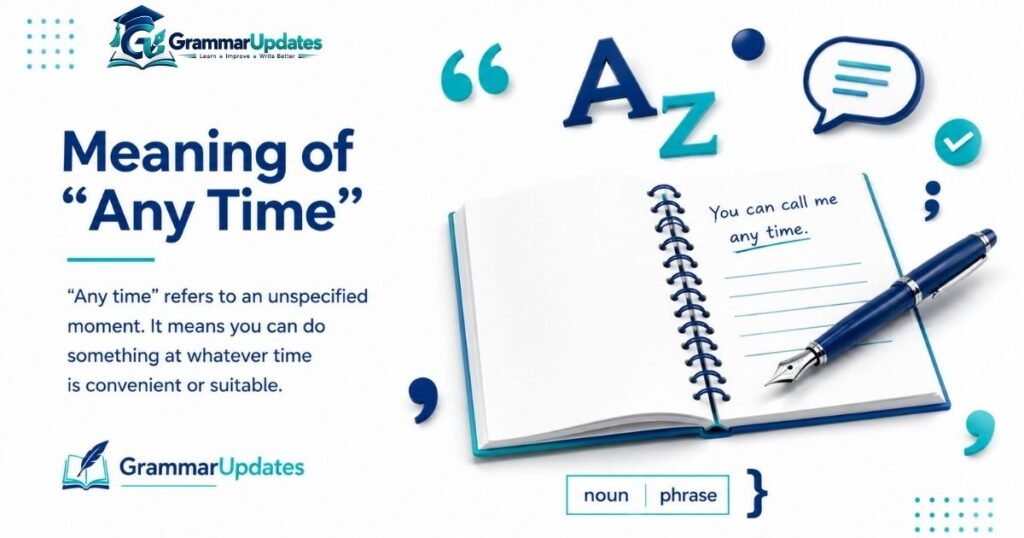
“Any time” is a phrase that resonates with flexibility and openness, capturing the essence of spontaneity in our busy lives.
It suggests an invitation to embrace the fluidity of time, where obligations dissolve, and moments can be seized without hesitation.
When to Use “Any Time”
Use any time when discussing:
- Available time
- Amount of time
- A specific period
- Scheduling
- Time that belongs to someone
Examples:
- Do you have any time this afternoon?
- I couldn’t find any time to finish the report.
- She rarely has any time for herself.
- We appreciate any time you can volunteer.
Common Sentence Patterns
You’ll frequently see:
- have any time
- spend any time
- find any time
- at any time
- during any time
Examples:
- We didn’t spend any time arguing.
- You may leave at any time.
- She cannot find any time to relax.
- The offer may end at any time.
Meaning of “Anytime”
“Anytime” serves as an adverb, which encapsulates immediacy and convenience. When you say, “You can leave anytime,” it implies a certain urgency or ease in departing without the constraints of a specific schedule.
When to Use “Anytime”
Choose anytime when it modifies a verb by telling when an action can happen.
Examples:
- Stop by anytime.
- You can message me anytime.
- Visitors are welcome anytime.
- Feel free to ask questions anytime.
In each sentence, the word answers the question When?
Anytime vs Whenever
One of the easiest grammar tricks is replacing anytime with whenever.
Examples:
✔ Visit us anytime.
→ Visit us whenever.
✔ Email me anytime.
→ Email me whenever.
If the sentence still sounds natural, anytime is the correct choice.
Any Time vs Anytime: Side-by-Side Comparison
The words “any time” and “anytime” often create confusion, but their subtle distinctions can significantly impact meaning.
“Any time” functions as a noun phrase, implying an open-ended range of time, inviting flexibility. For instance, saying “You can call me any time” suggests that you’re open to receiving calls at any point, emphasizing availability and freedom in the decision-making process. This nuance can change the tone of your communication, making it more inviting and approachable.
“Anytime” serves as an adverb, which encapsulates immediacy and convenience. When you say, “You can leave anytime,” it implies a certain urgency or ease in departing without the constraints of a specific schedule.
This subtle shift in usage informs context and emotional tone, transforming the message from a general availability to an action-oriented sentiment, guiding how the recipient interprets the invitation. By honing in on these distinctions, you can communicate more effectively and enrich your interactions with precision and clarity.
| Feature | Any Time | Anytime |
| Word Type | Two-word noun phrase | One-word adverb |
| Meaning | An amount or period of time | Whenever or at any moment |
| Formal Writing | Preferred where a noun phrase is required | Accepted in modern English as an adverb |
| Can Replace with “Whenever”? | No | Yes |
| Used After Prepositions? | Yes | Usually No |
| Example | I don’t have any time today. | Call me anytime. |
| Grammar Function | Refers to time itself | Describes when something happens |
Common Grammar Rules You Should Never Forget
Mastering grammar is like wielding a powerful tool that enhances your writing’s clarity and effectiveness. One vital rule is the proper use of subject-verb agreement, which ensures your sentences flow smoothly.
Straying from this rule often confuses readers, making your message less impactful. For instance, saying “The group of students are excited” instead of “The group of students is excited” can subtly shift the focus and clarity of your intent.
Another rule that deserves attention is the nuanced use of commas. Many writers underestimate the comma’s ability to clarify meaning. Consider the difference between “Let’s eat, Grandma” and “Let’s eat Grandma.”
A well-placed comma can save lives figuratively speaking! This illustrates how punctuation isn’t merely decorative; it’s essential for conveying your exact message without ambiguity. Practicing these rules not only hones your skills but empowers you to express ideas with precision and flair.
Rule 1: Use “Any Time” After Prepositions
When the phrase follows a preposition such as at, for, during, in, or without, the correct form is almost always any time because it functions as a noun phrase.
Examples
- You may leave at any time.
- We didn’t have any time for lunch.
- She worked without any time to rest.
- You can cancel your subscription at any time.
- I haven’t had any time this week.
This is one of the most reliable grammar rules to remember.
Rule 2: Use “Anytime” as an Adverb
If the word tells when something can happen, use anytime.
Examples
- Call me anytime.
- You’re welcome anytime.
- Come back anytime you need assistance.
- Feel free to contact us anytime.
In each sentence, anytime modifies the verb and answers the question “When?”
Rule 3: Replace It with “Whenever”
A quick editing trick is to replace the word with whenever.
If the sentence still makes sense, anytime is correct.
✔ Visit us anytime.
→ Visit us whenever.
✔ Email me anytime.
→ Email me whenever.
However:
✘ I don’t have whenever today.
Therefore, the correct sentence is:
✔ I don’t have any time today.
Rule 4: Formal Writing Requires Extra Attention
If you’re writing:
- a university paper
- a legal document
- a business proposal
- a government report
always double-check your usage.
Any Time vs Anytime Soon
“Anytime soon” adds a layer of urgency, hinting at an imminent timeframe. It brings a sense of expectation that can stir excitement or anxiety, depending on the context. This phrase compactly conveys the idea that while action may not be immediate, it’s certainly on the horizon.
It indicates that the wheels are turning, hinting that change or action is just around the corner, like the anticipation that builds before a long-awaited event. Embracing these nuances can enrich communication, transforming ordinary exchanges into dynamic dialogues filled with potential.
Any Time vs Anytime Examples
The distinction between “any time” and “anytime” often confuses writers, yet understanding their nuances can elevate your communication clarity. “Any time” is a phrase that emphasizes the idea of any specific occasion; it can be used in contexts where time is flexible or variable.
For example, saying, “You can call me any time,” indicates you’re open to receiving calls at various moments, with emphasis on the word “time” marking its importance.
On the flip side, “anytime” is more casual and often functions as an adverb, suggesting an informal take on flexibility. It conveys a sense of ease and availability.
For instance, in a sentence like “You can visit anytime,” the speaker implies an openness without the need for formality, making it feel more inviting. Recognizing these subtleties not only sharpens your writing but also enhances interpersonal communication, conveying the right tone and formality suited to different situations.
Any Time vs Anytime in Response to Thank You
In conversations, the subtle nuances between “any time” and “anytime” can shape the tone of your response to a “thank you.”
“Any time” suggests a comforting openness, almost like extending a warm invitation for future interactions, reinforcing that the kindness was not just a one-off gesture.
It’s an affirmation of ongoing support, emphasizing a willingness to help whenever needed, making relationships feel more robust and available.
“Anytime” feels casual and relaxed, conveying a sense of ease in your willingness to assist but lacking the same depth of connection.
Any Time vs Anytime Merriam Webster
“Anytime” serves as an adverb, often conveying a more casual or informal tone. It’s perfect for responses like, “You can borrow my book anytime,” which reflects a general availability without the specificity tied up in its two-word counterpart.
This distinction adds layers to our communication, allowing us to express nuances of formality and immediacy that can shift the meaning of a conversation. Embracing these subtleties can enhance your writing and speaking, enabling you to convey the intended message with greater precision.
Any Time vs Anytime in a Sentence
The distinction between “any time” and “anytime” often stirs debate, yet understanding their nuanced differences can enrich your communication. “Any time,” two words, serves as a phrase typically used in contexts where time is a measurable concept, often linked with prepositions.
For instance, saying “You can contact me at any time” emphasizes the openness of availability, indicating a range of specific moments.
In contrast, “anytime,” a single word, functions more as an adverb, conveying a sense of entitlement or permissiveness: “Feel free to call me anytime.” This usage infers a broader, more casual invitation, suggesting that there are no constraints to the time you choose to reach out.
By recognizing these subtle shifts, writers and speakers can craft messages with greater precision, ultimately enhancing clarity in our daily interactions. Each choice can impact the tone and intent, allowing for a more personalized connection with the audience.
Any Time vs Anytime Between
The distinction between “any time” and “anytime” often puzzles writers and speakers alike, yet grasping their nuances can significantly enhance clarity in communication.
“Any time” is a phrase that refers to any specific instance in time, typically used in contexts where one could replace it with “any moment” or “whenever.”
For instance, saying, “You can call me any time,” implies flexibility and openness, suggesting that the listener has a wide range of options to choose from.
On the other hand, “anytime” functions more like an adverb, often conveying informality and ease. It’s commonly used in casual exchanges, such as “You can stop by anytime,” which reflects a welcoming attitude rather than simply indicating availability.
While both phrases may seem interchangeable in casual discourse, understanding their specific uses can add depth to your writing. Embracing these subtle differences empowers you to convey your intentions more precisely, enhancing both the richness and effectiveness of your communication.
Any Time vs Anytime After
“Any time” and “anytime after” might seem interchangeable at first glance, but they convey nuanced differences that can significantly affect communication.
“Any time” refers to a period open to possibilities, suggesting flexibility and readiness to engage in something at any moment. It’s an invitation that implies, “I’m here, and I’m ready whenever you are.” This phrasing can foster a sense of openness in conversations, making it feel less formal and more approachable.
On the other hand, “anytime after” carries a subtle implication of scheduling and boundary-setting. It conveys that although there’s flexibility, there are also conditions specifically, a defined beginning or precondition that must be met before engagement can occur.
This phrase can be particularly effective in professional settings, where it delineates clear timelines while still allowing for openness. Understanding these phrases not only sharpens your communication but also enhances your ability to convey subtle intentions and establish stronger connections with others.
Any Time vs Anytime AP Style
In the world of AP Style, the distinction between “any time” and “anytime” can often feel perplexing, yet it carries weight in precise communication. “Any time” is typically used as a phrase referring to an unspecified amount of time.
For example, you’d say, “You can call me any time you like,” emphasizing the flexibility of moments. This phrasing allows for a more formal tone, ideal in professional contexts where clarity is paramount. If you are interested have a one look on Breath or Breathe.
“Anytime” functions as a more casual adverb, suggesting an indefinite point in time but often used in informal settings. For instance, “You can drop by anytime” conveys a friendly openness, inviting spontaneity.
Understanding these subtle differences enriches writing and enhances reader comprehension, reminding us that language is not just about what we say but how we say it. Ultimately, mastering these nuances allows writers to communicate with precision while adapting their tone to suit the audience and context.
Common Mistakes Writers Make
One common mistake writers often make is misusing “any time” and “anytime.” While they may seem interchangeable, understanding their distinct meanings can elevate your writing.
“Any time” functions as a noun phrase referring to an unspecified amount of time, while “anytime” serves as an adverb meaning “whenever.” This nuanced difference is crucial, particularly when striving for clarity.
Mistake 1: Writing “Anytime” After a Preposition
- You may leave at anytime.(wrong)
- You may leave at any time.(correct)
Mistake 2: Using “Any Time” as an Adverb
Call me any time.(wrong)
✔ Call me anytime.
Although some style guides accept both in informal writing, anytime is generally the preferred adverb.
Mistake 3: Assuming They Are Always Interchangeable
Many learners think the two forms always mean the same thing.
They don’t.
Choosing the correct form depends on grammar, not just meaning.
Mistake 4: Ignoring Sentence Structure
Instead of memorizing one rule, identify the sentence’s function.
Ask yourself:
- Is this referring to time itself?
- Or is it describing when something happens?
That single question usually gives you the correct answer.
Language Trends and Usage (2025–2026)
Recent writing guidance from major language authorities continues to recognize a clear distinction between any time and anytime.
- Modern dictionaries, including Merriam-Webster and Cambridge Dictionary, list anytime as a standard adverb meaning whenever.
- Most grammar style resources still recommend any time whenever the phrase functions as a noun or follows a preposition.
- Digital writing assistants and grammar checkers increasingly flag incorrect combinations such as “at anytime”, encouraging writers to use “at any time” instead.
- With AI-assisted writing becoming more common in 2025–2026, careful human proofreading remains essential because automated tools can still miss context-dependent grammar choices.
Self Assessment
Try These:
- Call me ______ you need help.
- I don’t have ______ today.
- You can visit us ______ you like.
- Do you have ______ available tomorrow?
- Feel free to message me ______.
- I didn’t have ______ to finish my homework.
- You may leave at ______.
- Our support team is available ______.
- Come back ______ you need help.
- I don’t have ______ to wait.
- You can call me ______.
- Is there ______ left before the meeting?
- You may contact us ______.
- We don’t have ______ to waste.
- You can cancel your subscription at ______.
- She said I could visit ______.
- I haven’t had ______ to eat today.
- Please call me ______ you are ready.
- Do you have ______ for a quick meeting?
- You can stop by ______.
Key Answers:
- Anytime
- Any time
- Anytime
- Any time
- Anytime
- Any time
- Any time
- Anytime
- Anytime
- Any time
- Anytime
- Any time
- Anytime
- Any time
- Any time
- Anytime
- Any time
- Anytime
- Any time
- Anytime
Explore: Shown vs Showed: The Complete Guide To Using These Two Forms
Conclusion
Any Time vs Anytime may seem interchangeable at first glance, understanding their distinct uses can enhance clarity in communication. “Any time” refers to a specific instance or amount of time, often utilized in questions and conditional statements, whereas “anytime” serves as an adverb, conveying a more general idea of at any point.
Recognizing this difference can prevent misunderstandings and improve the quality of your writing. Remember, precision in language not only reflects professionalism but also elevates the reader’s experience. So, the next time you write, choose wisely your words matter!
FAQs
Is it anytime or any time after 2pm?
The correct phrase is “any time after 2 PM.” “Any time” refers to an unspecified duration or moment, while “anytime” means “at any moment” but is typically used in more casual contexts. So, if you mean to indicate a flexible period that starts after 2 PM, it’s best to use “any time.”
Is it anytime or any time after thank you?
The correct phrase is “any time” when used in the context of referring to an unspecified amount of time. For example, you might say, “You can reach me any time after 5 PM.” “Anytime” is used as an adverb meaning “at any time” and is often used in informal contexts.
Is it any time or anytime on Friday?
The correct phrase is “anytime,” as it refers to an unspecified point in time. So you would say, “Is it anytime on Friday?” This usage indicates you’re asking if something is possible at any moment during that day.
What does “anytime” mean?
“Anytime” refers to an indefinite time frame, suggesting that something can happen or be done at any moment or at your convenience. It conveys flexibility and openness concerning timing, allowing for spontaneity or scheduling based on individual preference.