
Bougie or Boujee: Which One Should You Use?
This playful twist on a word reflects more than just linguistic quirks; it encapsulates social status, cultural identity, and the allure of luxury. We’ll dive into the origins of “Bougie or Boujee”, explore their meanings in modern vernacular, and unpack their significance in today’s society. By the end, you’ll be equipped to navigate these terms with confidence, understanding their role in contemporary conversations.
Bougie or Boujee Meaning in English
The terms “bougie” or “boujee” have transcended their original connotations, evolving into cultural signifiers that encapsulate a specific lifestyle and mindset.
Derived from the French word “bourgeois,” these expressions often describe an individual’s inclination toward luxury and sophistication, sometimes tinged with a hint of irony.
In today’s vernacular, being bougie isn’t just about wealth; it encapsulates a desire for the finer things in life, whether that’s artisanal coffee, organic meals, or curated experiences. The nuance lies in how one navigates this lifestyle embracing it as genuine aspiration or critiquing it as superficial pretense.
Bougie Meaning
“Bougie” has taken on a dual edge; it can signal aspiration or, conversely, pretentiousness. This juxtaposition invites a deeper conversation about authenticity in an age where social media amplifies images of luxury and desire.
Examples:
- That rooftop restaurant feels incredibly bougie.
- She only drinks imported sparkling water because she’s so bougie.
- Their living room has a very bougie design.
Boujee Meaning
The term “boujee” often evokes images of affluence and lavish lifestyles, but its roots tell a more nuanced story.
Examples:
- We’re feeling boujee tonight.
- That café looks so boujee.
- Weekend plans? Just being boujee.
Why Do People Get Confused?
Confusion often arises from the overwhelming amount of information we encounter daily. In an age defined by instant access to countless perspectives, it’s easy to feel lost in a sea of differing opinions, especially when trying to navigate complex social cues or trends.
Take, for example, the way people debate the difference between Bougie or Boujee. While both terms draw from the same roots, their usage can vary widely, leading to misunderstandings that spiral into confusion.
The confusion exists because both words:
- Have the same pronunciation.
- Express similar ideas.
- Appear frequently online.
- Are accepted by different communities.
As a result, many writers wonder whether one is “correct” and the other is “wrong.” The answer depends more on context than grammar.
Bougie or Boujee: Which One Is Correct?
The confusion surrounding “bougie” and “boujee” highlights the evolving nature of language, especially as it adapts to cultural shifts.
Originally derived from the French word “bourgeois,” which referred to the middle class, both terms have morphed in modern slang to denote someone who aspires to or exhibits a luxurious lifestyle.
While “bougie” is often considered the more traditional spelling, “boujee” has gained popularity, especially in social media circles, energized by cultural influencers and hip-hop lyrics.
Simple Answer
| Situation | Best Choice |
| Formal writing | Bougie |
| Blogs and articles | Bougie |
| News writing | Bougie |
| Academic work | Bougie |
| Social media captions | Boujee or Bougie |
| Song lyrics | Usually Boujee |
| Casual conversations | Either works |
Quick Answer of Bougie or Boujee
If you’re unsure which version to choose, use bougie.
It’s more widely recognized in dictionaries, style discussions, and professional writing while still sounding modern.
Is Boujee Wrong?
Not wrong
It isn’t necessarily incorrect, but it’s considered a creative or pop-culture spelling rather than the traditional one.
Think of it as the difference between standard language and internet language.
For example:
- Formal article: “The restaurant has a bougie atmosphere.”
- Instagram caption: “Brunch with my boujee friends.”
Both sentences communicate the same idea, but the second matches a more casual, online audience.
Bougie or Boujee Pronunciation
The debate around the pronunciation of “bougie” or “boujee” often brings to light a clash of cultural interpretations. Rooted in French, “bourgeois” highlights a life of luxury and privilege, but in contemporary slang, it’s embraced, reshaped, and sometimes even mocked.
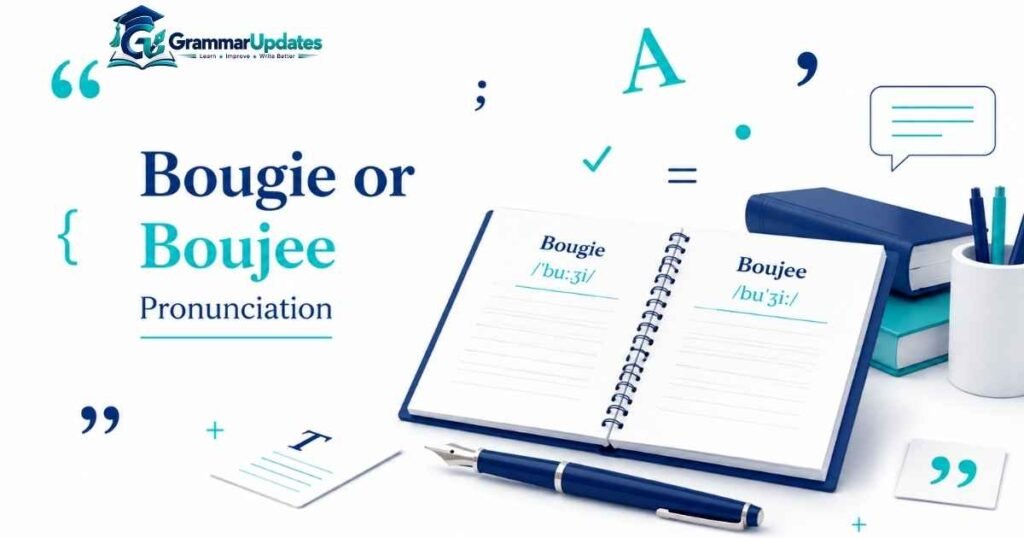
Bougie and Boujee (BOO-zhee)
Even among friends, the term can trigger conversations about class and authenticity, complicating what might seem like a simple pronunciation issue.
Pronunciation Breakdown
In the realm of pronunciation, subtle nuances can transform a simple word like “breathe” into a lesson on phonetics. The distinction between “breath” and “breathe” exemplifies this beautifully.
While “breath” captures the essence of the air we inhale, “breathe” embodies the action itself, a dynamic interplay of sound and meaning.
| Word | Pronunciation | Sounds Like |
| Bougie | BOO-zhee | “Boo” + “zhee” |
| Boujee | BOO-zhee | “Boo” + “zhee” |
Common Pronunciation
Understanding common pronunciation pitfalls is essential for effective communication, especially when it comes to trendy terms like “bougie” or “boujee.” Despite their popularity, many people mispronounce these words, often leading to confusion.
“Bougie,” derived from bourgeois, carries connotations of pretentiousness or an extravagant lifestyle, while “boujee” has taken on a more playful, self-aware tone in modern slang.
❌ Boo-jee
❌ Bow-jee
❌ Boo-gie
❌ Boo-gee
The correct pronunciation is BOO-zhee, where the second syllable has a soft “zh” sound, similar to the middle sound in “measure” or “vision.”
Mistakes Pronunciation Tip
One of the most common mistakes in pronunciation occurs when speakers overlook subtle vowel sounds. Consider the difference between “bead” and “bid”; the shift in the vowel can entirely alter the meaning of a word. Explore more how English speakers pronouce and use other words as Hola or Ola.
To tackle this, try incorporating minimal pairs words that differ by just one sound into your practice. This not only sharpens your ear for nuanced pronunciation but also enhances your overall vocal modulation.
If you’re unsure, remember this simple trick:
Think of “Boo” + “zhee” = BOO-zhee.
Bougie or Boujee Origin
The term “bougie” or “boujee” has evolved significantly from its origins in the 19th-century French word “bourgeois,” which described the middle class, particularly those who adopted a lifestyle associated with wealth and privilege.
Today, it carries connotations that sometimes veer into sarcasm, labeling those who flaunt their affluence or crave luxury with a hint of mockery.
It encapsulates a cultural critique of aspiration, where one’s pursuit of the finer things be it trendy cafés or high-end fashion can reveal deeper societal divides.
From Bourgeois to Bougie
Today, someone might be called bougie because they:
- Prefer luxury brands.
- Love gourmet coffee.
- Choose high-end restaurants.
- Decorate their home with premium furniture.
- Spend extra money on fashionable experiences.
How Boujee Became Popular
The rise of the term “bougie” or “boujee” reflects a cultural shift where affluence is both celebrated and scrutinized. Initially popularized in hip-hop and urban culture, the word encapsulates the tension between aspiration and authenticity.
Artists like JAY-Z and Cardi B have woven it into their lyrics, imbibing it with a playful yet critical tone, emphasizing not just wealth but also the sometimes absurd lengths to which people go to appear sophisticated.
Language Keeps Changing
Language is a living entity, continuously molding itself to reflect societal shifts and cultural dynamics. Take the term “bougie,” often used to describe someone with pretentious tastes, especially in social contexts.
Its roots trace back to the French word “bourgeois,” which originally referred to the middle class, but its evolution speaks volumes about our contemporary fixation on status and appearance. What was once a critique has transformed into a badge of honor among those who navigate luxury and lifestyle trends, illustrating how language adapts to our values.
When Should You Use Bougie?
Using a bougie can elevate various dining experiences, particularly when the meal involves intricate foods or delicate presentations.
For instance, if you’re indulging in sushi or a gourmet bistro dish, navigating these culinary masterpieces with precision can enhance not just taste but also the decorum of the occasion. A bougie serves as an elegant tool, adding an air of sophistication and ensuring that even the smallest bites are experienced fully.
In Professional Writing
Professional writing extends far beyond the mere act of putting pen to paper or fingers to keyboard; it’s about crafting clear, purposeful communication that resonates with its intended audience. This form of writing is deeply rooted in understanding not just the message, but the unique context in which it exists.
Examples:
- Blog posts
- Magazine articles
- Marketing content
- News websites
- Educational resources
In Everyday Conversation
In everyday conversation, the art of listening often overshadows the act of speaking. Many individuals rush to respond or contribute their own experiences instead of fully absorbing what the other person is conveying.
This missed opportunity limits the depth of connection; when we truly listen, we not only validate the speaker but also enrich our own understanding.
For example:
- “Their new apartment is so bougie.”
- “This coffee shop is kind of bougie.”
In Social Media
Navigating the ever-evolving landscape of social media is like steering a ship through shifting tides. With new platforms emerging and algorithms constantly changing, staying relevant demands a blend of creativity and adaptability.
Brands that lean into authenticity resonate more with audiences; today’s users crave genuine interactions over polished facades. This shift encourages businesses to showcase their human side, making behind-the-scenes content increasingly valuable.
For example:
- Luxury influencer: “Living my boujee life.”
- Lifestyle blogger: “A surprisingly bougie café hidden downtown.”
When Should You Use Boujee?
Using “bougie” in a playful way can convey irony or self-awareness, especially when discussing your own habits. For instance, enjoying artisanal coffee while wearing thrift store finds adds a humorous twist to the concept.
In contrast, using it to describe someone else’s lavish tendencies should always remain respectful, as it can invite unintended judgment or ridicule. Understanding the balance between genuine admiration and playful critique is key to wielding “bougie” with sophistication.
On Social Media
On social media, the term “boujee” takes on a life of its own, often signifying a lifestyle driven by aesthetics and exclusivity. It’s not just a descriptor for luxury; it’s a cultural phenomenon that shapes how we present ourselves online.
Platforms like Instagram and TikTok have transformed the concept of being boujee into a visual masterpiece, with users curating feeds that showcase everything from high-end fashion to exotic dining experiences. This curated life can create an intoxicating allure, drawing followers into a world where aspiration and reality often collide.
Examples:
- “Feeling a little boujee after my spa day.”
- “Coffee in hand, matching outfit, and a boujee brunch.”
- “Weekend mood: staying boujee.”
In Music and Pop Culture
The boujee aesthetic infiltrates fashion, influencing trends that embrace both boldness and sophistication. From lavish streetwear to high-end collaborations, the pop culture landscape reflects a desire for opulence that is relatable and aspirational.
It speaks to a generation that thrives on individuality while navigating the complexities of economic disparity.
When Writing for Younger Audiences
Writing for younger audiences requires an understanding of their unique cultural contexts and values. Today’s kids and teens are navigating a boujee landscape filled with social media influencers, fast fashion, and ever-evolving trends.
Engaging this demographic goes beyond just using trendy slang; it involves crafting relatable narratives that resonate with their experiences. They crave authenticity, so bringing genuine emotions into stories allows them to see themselves both in characters and situations.
Bougie or Boujee UK
In recent years, the terms “Bougie” or “Boujee” have transformed from a niche slang to a cultural phenomenon in the UK, often signifying a lifestyle that embraces luxury and excess, sometimes with a touch of irony. If you are interested you can see more Breath or Breathe in the UK.

This playful usage captures a unique blend of aspiration and self-awareness, reflecting a generation eager to showcase their success while navigating the complexities of social media. Picture a Sunday brunch where artisan coffees and avocado toasts reign supreme, a perfect embodiment of the Boujee lifestyle, where it’s not just about the food but the experience.
However, it’s essential to differentiate between genuine aspirations and superficial displays. In an era where influencers set standards, the Bougie or Boujee aesthetic allows individuals to curate their lives visually, leading to a deeper conversation about authenticity.
Bougie or Boujee Medical
In the realm of healthcare, the discussion around “bougie” versus “boujee” takes on a surprising twist. While “bougie” refers to tools crucial for procedures, often seen in anesthesiology and intubation, “boujee” speaks to a lifestyle marked by luxury and extravagance.
This duality prompts an intriguing reflection on how medical practices can reflect broader societal trends.
Bougie or Boujee Meaning in Urban Dictionary
The term “bougie” or “boujee” has evolved from its roots in the French word for “bourgeois,” which originally described the middle class. It embodies a lifestyle that balances an appreciation for finer things with a hint of irony.
The Urban Dictionary captures this duality, defining boujee individuals as those who indulge in luxury while often playfully distancing themselves from overt elitism. This complexity speaks to a generation navigating social status through the lens of authenticity and self-awareness.
In a world where social media glorifies curated lifestyles, “boujee” has become a badge of honor for some, while simultaneously serving as a tool for critique. The term often evokes images of gourmet coffee, designer brands, and exclusive experiences, yet it also highlights the tension between aspiration and authenticity.
This nuanced interpretation reminds us that bougie isn’t merely about wealth; it’s about identity, community, and the playful ways we express ourselves in an increasingly complex social landscape.
Bougie or Boujee Reddit
The terms “bougie” and “boujee,” derived from the French word “bourgeois,” have evolved into a cultural commentary on class and lifestyle, particularly within online communities like Reddit.
Users often explore the nuances of what it means to be “bougie,” from extravagant brunches to designer fashion. It’s not just about wealth; it’s about the lifestyle choices that signal one’s social status, whether you’re sipping artisanal coffee or debating the merits of organic quinoa.
What’s fascinating is the playful way Redditors dissect these lifestyles, often blurring the lines between genuine aspiration and ironic self-awareness. Many subreddits serve as a stage for users to share both their bougie choices like spontaneous luxury travel and the pitfalls of striving for a lifestyle that might feel unattainable.
Bougie or Boujee Australia
Australia’s cultural landscape is a vibrant tapestry woven with diverse influences that cater to both high-end and laid-back lifestyles. The term “bougie” has evolved beyond its original connotation, becoming a catchphrase for those who appreciate life’s finer things without losing touch with authenticity.
From chic coastal eateries in Bondi to artisanal markets in Byron Bay, Australians have embraced this duality, creating spaces where luxury and laid-back charm coexist harmoniously.
In cities like Melbourne, where cafe culture reigns supreme, the aesthetic of indulgence can be tasted in every meticulously crafted flat white, yet the spirit remains refreshingly unpretentious. This preference for authenticity over ostentation speaks to a broader, modern notion of success that prioritizes experiences over mere possessions.
Bougie vs Boujee: Quick Comparison
When discussing “bougie” versus “boujee,” it’s essential to recognize their cultural contexts. Originally derived from the French word “bourgeois,” “bougie” refers to a lifestyle associated with the middle class and, more specifically, an aspiration to a higher social status.
“Boujee,” often used in modern slang, emphasizes a more flamboyant, flashy demeanor, evoking images of luxury and opulence. While many interchange these terms, the connotation of “boujee” leans more towards a playful critique of those who flaunt their wealth or refined tastes in a sometimes pretentious manner.
| Feature | Bougie | Boujee |
| Meaning | Luxurious, fancy, upscale | Same meaning |
| Pronunciation | Boo-zhee | Boo-zhee |
| Origin | Shortened from bourgeois | Pop-culture spelling |
| Formal Writing | Recommended | Not recommended |
| Social Media | Common | Very common |
| Academic Writing | Yes | Avoid |
| Dictionaries | More widely recognized | Less commonly listed |
| Tone | Standard and modern | Trendy and informal |
Which One Should You Choose?
Choose bougie if you’re writing
- Blog posts
- Business content
- School assignments
- News articles
- Professional emails
Choose boujee if you’re writing
- Instagram captions
- TikTok videos
- Casual text messages
- Entertainment content
- Humorous posts
Bougie vs Boujee in Everyday Sentences
Understanding the difference becomes much easier when you see both words used in real-life situations.
Everyday Examples Using Bougie
- That new rooftop restaurant looks incredibly bougie.
- She loves shopping at luxury boutiques because she’s a little bougie.
- Their apartment has a bougie modern design.
- He ordered truffle fries because he was feeling bougie.
- Our vacation was surprisingly bougie for the price.
- The hotel lobby had a very bougie atmosphere.
- She decorated her office with bougie furniture.
- This coffee shop serves a bougie version of hot chocolate.
Everyday Examples Using Boujee
- We’re feeling boujee tonight, so let’s dress up.
- That brunch spot is so boujee!
- Living my boujee life one latte at a time.
- She posted another boujee vacation photo on Instagram.
- My friends love taking boujee selfies.
- Weekend plans? Staying boujee and relaxing.
- That outfit looks seriously boujee.
- This café is perfect for a boujee Instagram photo.
Common Mistakes People Make
One of the most common mistakes people make is getting caught up in the allure of a bougie lifestyle without understanding its true essence. Many believe that luxury is solely about expensive labels and lavish experiences, often leading to financial strain and dissatisfaction.
Instead of curating a personal style that reflects individuality, they chase trends, drowning in an ocean of materialism. Embracing simplicity and authenticity can yield a more fulfilling life, allowing one to enjoy quality over quantity.
Another pitfall lies in social media comparisons, where the highlight reels of boujee influencers create unrealistic standards of happiness and success. This can result in feelings of inadequacy and anxiety, pushing individuals to overspend or stick to unhealthy habits just to keep up.
Better:
“The restaurant has a bougie atmosphere.”
Instead of:
“The restaurant has a boujee atmosphere.”
Assuming They Have Different Meanings
In today’s cultural lexicon, the terms “bougie” and “boujee” often pop up in conversations, but their nuanced meanings might surprise you. While both terms derive from the French word “bourgeois,” they can evoke distinctly different images.
“Bougie” typically refers to a pretentiousness associated with aspiring to a lifestyle that’s often deemed excessive or overly refined. On the other hand, “boujee” tends to embrace a more playful, almost self-aware version of this luxurious aspiration, often used humorously to describe someone enjoying finer things yet acknowledging their roots.
Forgetting Your Audience
Always think about who’s reading your content.
- Teachers expect bougie.
- Friends may enjoy boujee.
- Search engines understand both, but evergreen educational content generally performs better with bougie as the primary spelling.
Self Assessment Quiz
Try These:
- The article described the new restaurant as ______.
- OMG this brunch spot is so ______ .
- In her essay, she called the trend ______ consumerism.
- That caption said the party was mad ______.
- The professor’s research paper used the word ______.
- Bro this hotel room is straight up ______.
- The newspaper review called the decor ______.
- Her Instagram story captioned the outfit “feeling ______.”
- The dictionary lists ______ as the standard spelling.
- That TikTok trend made everything look ______.
- The business blog described the service as ______.
- Ngl these shoes are kinda ______.
- The style guide recommends using ______ in formal writing.
- Her tweet said the wedding was “so ______.”
- The academic journal referred to the culture as ______.
- That Snapchat filter made the vibe look ______.
- The formal report avoided slang and used ______.
- Y’all this cafe is way too ______ for me lol.
- The magazine’s print edition spelled it ______.
- His meme caption joked about being “______ on a budget.”
Key Answers:
- Bougie
- Boujee
- Bougie
- Boujee
- Bougie
- Boujee
- Bougie
- Boujee
- Bougie
- Boujee
- Bougie
- Boujee
- Bougie
- Boujee
- Bougie
- Boujee
- Bougie
- Boujee
- Bougie
- Boujee
Explore: Shown vs Showed: The Complete Guide To Using These Two Forms
Conclusion
You choose to spell it bougie or boujee, the term reflects more than just a style; it encapsulates a lifestyle and a cultural statement. Understanding the nuances behind each variation can enhance your appreciation for the term in its various contexts.
While “bougie” carries its own connotations of pretentiousness and class aspirations, “boujee” often embraces a more playful and self-aware attitude. Both variations illustrate how language evolves and adapts within social frameworks. So, next time you use the term, consider which spelling resonates with your message, and let your voice shine through.
FAQs
Does Boujee Mean Fancy?
Yes, boujee (also spelled bougie) means fancy, luxurious, or high-class
What is a Bougie Girl?
A bougie girl is a woman who loves luxury, high-end products, and a fancy lifestyle, whether she truly has the wealth for it or is just acting like it.
What does “Boujee” Mean?
“Boujee” (often spelled bougie) is slang for high-class, fancy, or luxurious. It describes people, places, or things that like expensive, top-tier items or an upper-class lifestyle.
Is Bougee an Insult?
Whether “boujee” (or its relative “bougie”) is an insult depends heavily on the context, tone, and specific spelling used.